The Body's First Vote
New Concepts for Nietzsche & Deleuze's Philosophy of Forces

A sunflower, blind and brainless, twists its neck to track the sun across the sky. An immune cell, a microscopic guard in the dark sea of your blood, bumps against a billion different molecules a day. Most it ignores. But when it touches one specific alien protein, a spike on a virus it has never before encountered, it sounds an alarm that mobilizes an entire defense system.
How does it know?
How does the flower feel the path of the light? How does the cell distinguish friend from foe? There is no thought, no deliberation, no judgment in the way a courtroom understands it. There is only a raw, immediate, and world-defining encounter. A vote is cast long before a mind has time to assemble a ballot.
This is a question that much of philosophy, in its rush to enthrone human reason, has forgotten to ask. We have an exhaustive literature on how we judge value, but we have almost no language for how life selects it in the first place. The prevailing story, handed down from Immanuel Kant, sees value as a verdict delivered after the fact. In his Critique of Judgment, Kant pictures a mind sorting through the world, measuring particulars against universal concepts. Does this creature fit the category of ‘dog’? Does this action align with the principle of ‘goodness’? Value is the prize awarded once an object has been properly filed in the mind’s cabinet. It is a secondary, retrospective affair.
But life doesn’t wait for the filing to be finished. It is a storm of forces, a clash of intensities, a constant negotiation of capacities. If value is to be more than a philosopher’s parlor game, it must be forged in these initial encounters. There must be an unseen sieve, a pre-cognitive filter, that sorts the world into what nourishes and what poisons before we are even aware a choice is being made. Here, I conduct a preliminary search for that sieve.
Nietzsche’s Hammer and the Crack in the Foundation
The demolition crew arrived in the form of Friedrich Nietzsche and, later, his most explosive interpreter, Gilles Deleuze. They took a hammer to the Kantian courthouse. They argued that value doesn't spring from a detached, rational subject, but from the will of life itself—a will to power.
For them, a value is a symptom, a footprint left by a certain quality of force. When Nietzsche asks, "What is the value of our values?", he’s trying to diagnose them, not justify them. What kind of life produced them? A life overflowing with power, that actively stamps its form onto the world? Or a life diminished and reactive, that defines itself by what it is not?
Deleuze sharpened this tool in Nietzsche and Philosophy. He called evaluation the "differential element of forces." To evaluate is to determine the quality of the forces present in a body, an institution, or an idea. Is it active, a force that commands and organizes? Or is it reactive, a force that can only obey and respond? Evaluation becomes a kind of geology of morals, exposing the strata of forces that lie beneath our most cherished beliefs.
This is a powerful weapon; with it, the genealogist can unmask the humble origins of so-called universal truths. But the hammer, for all its force, still swings a little too late. It can diagnose the state of a body—healthy or sick—but it doesn't explain how it got that way. It presupposes that the forces have already been sorted, that the encounter has already happened.
A crack remains in the foundation. Nietzsche and Deleuze's evaluation can read the symptoms like a good doctor, but it can’t explain the moment of infection or nourishment. It tells us why a system is failing, but not how it first failed to choose life. The most embryonic wager has already been made, and we, physicians, are left diagnosing the results.
Pathic Selection
We need a name for that primordial sieve. I call it pathic selection.
The term pathic points to pathos—an immediate, affective tonality or a vibration felt before thought. As Deleuze insists, the will to power is "first of all a pathos," not a plan. Pathic selection is the event where a body, an assemblage, or a force feels an encounter and tilts, in an instant, toward or away from it.
There is no comparison of identities, no checking against a list of criteria. There is only one question: Does this encounter amplify my power to become, or does it contract it? A new idea flashes across your mind. A stranger’s gaze meets yours across a room. A rhythm hooks you from a passing car. Before you can name it, before you can judge it, your body has already voted. It leans in, folding the intensity into its own circuits, or it recoils, erecting a subtle barrier.
This is the selective principle that Nietzsche tried to capture with his most daunting thought: the Eternal Return. What if, he asks in The Gay Science, a demon were to tell you that you must live this life, this very moment, again and again for eternity?
"Would you not throw yourself down and gnash your teeth and curse the demon who spoke thus? Or have you once experienced a tremendous moment when you would have answered him: 'You are a god and never have I heard anything more divine!'"
Deleuze understood that this is not a cosmological theory but the ultimate test of pathic selection. To will the eternal return of a moment is to affirm that its intensity was so purely expansive, so perfectly aligned with your power to become, that you would welcome it forever. It is the final "Yes" to an encounter. Pathic selection is the microscopic, continuous process of casting such votes, moment by moment.
Reactive Calibration and The Art of the Healthy No
So, the body casts its vote. It says Yes to certain intensities. But what happens next? Not all forces are purely active. Life is a messy mixture, a complex entanglement where any action requires resistance, and any creation involves navigating constraints. What does a healthy body do with the friction, the opposition, the reactive qualities of force it inevitably encounters and even needs?
A common misreading of Nietzsche paints him as a cheerleader for a blind, explosive "letting go," for a life of pure, unhindered impulse. This misses the subtlety of his work, and of Deleuze’s. Such a life would not be powerful but instead a brief flare-up, quickly exhausted. Nietzsche's ideal is the "great health," which is always a state of overcoming, of discipline. A healthy life doesn't expel reactivity but puts it to work. It recognizes that what is required is a choreography of forces.
This is the work of reactive calibration. Once an intensity has passed the threshold of pathic selection, its reactive elements must be managed. A healthy organism develops what Nietzsche called an active "faculty of forgetting." This isn't a passive lapse in memory; it is a digestive force, the "stomach of the spirit." It actively neutralizes the traces of past encounters, clearing psychic space for the new. It prevents the nervous system from becoming a cluttered archive of every old slight and shock.
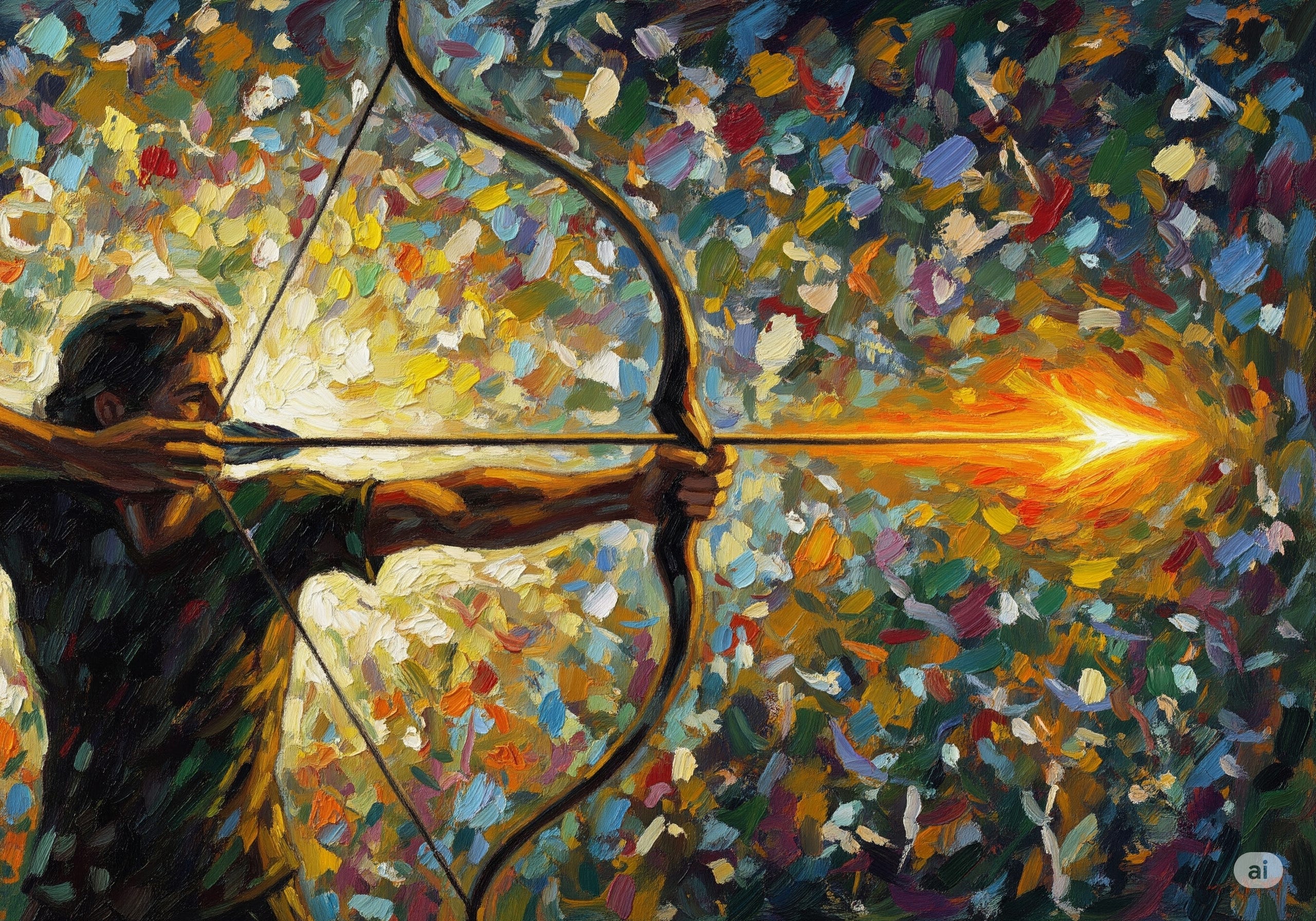
Deleuze, reading Nietzsche, identifies the threefold job of healthy reactive forces: they must "divide, retard, and delay the action." This is the art of the healthy no, the productive resistance that makes an affirmation meaningful. To divide an action is to give it rhythm, to break a single, crude impulse into a series of gestures. To retard and delay an action is to introduce the hesitation that creates focus. Think of an archer drawing a bow. The tension in the string is a reactive force that gathers and stores energy. The brief, steady pause before release is a delay that allows the eye, the arm, and the target to become a single system. This is precisely the source of precision. Without that calibrated resistance, the arrow would fly wildly, wasting its power.
Reactive calibration is the art of this productive delay, introduced by the healthy expression of reactive force in its choreography with active force. It is the rhythmic tuning that turns friction into focus, resistance into strength, and hesitation into style. The sickness Nietzsche called ressentiment is what happens when this calibration fails utterly. The reactive forces are no longer managed by an active will. They break free, seize command, and turn the healthy delay into a permanent, looping blockage. The brake becomes the engine. Instead of actively forgetting, the body passively obsesses. It hoards old wounds, and its only creative act is to poison the present with the past. The person of ressentiment needs an external cause to blame, an enemy to react against, just to feel alive.
The Three-Tier Machine of Value
We can now see a new machine for creating value, a dynamic process cascading through three schematic tiers.
At the base lies pathic selection, the primary affective filter. It is the ear of the body, listening for the resonance of augmenting power. It performs the first, decisive cut, an instantaneous, non-conscious vote of Yes or No.
Upon this foundation operates reactive calibration, the rhythmic hand that shapes what the ear has let in. Once an intensity is admitted, calibration modulates it, dividing, delaying, and orchestrating its reactive components. It turns the raw material of the encounter into a composed and focused choreography of forces, transforming potential chaos into precision.
Only after these two micrological tiers have done their work does evaluation emerge at the apex as a conceptual voice. This is the stage of the genealogist, the philosopher with her hammer. Here, the lived patterns that have been selected and calibrated are finally given names, ranked, and legislated as "values." The philosopher translates the non-discursive wisdom of the body into the language of concepts, morals, and laws.
This integrated machine gives the philosopher's hammer a solid foundation and a clear target. When Nietzsche and Deleuze attack a "slave morality," they are performing a specific diagnosis. They see a system where pathic selection has become inverted, consistently saying Yes to whatever diminishes and weakens life. They see a catastrophic failure of reactive calibration, where ressentiment has replaced the faculty of forgetting and runs rampant.
Their goal is not simply to smash these old value-tables but to clear the ground so that a healthier selective and calibrative apparatus can be built. This reframes the task of philosophy itself. As Deleuze and Guattari argued in What is Philosophy?, the philosopher's job is to create concepts. Pathic selection and reactive calibration are concepts designed as tools to solve a problem: how to think about value from the ground up, starting not with judgment, but with life itself.
So What?
All of this has concrete implications, too.
In ethics, Nietzsche's famous call to "give style to one's character" becomes an exhortation to become a master of reactive calibration. The aim is not to suppress passions or weaknesses; the real work lies in designing constraints that bend those very forces into unique and powerful expressions.
In politics, we can see institutions as massive calibrative devices. Consider the difference between retributive and restorative justice. A retributive system takes the reactive anger of a community and converts it into crude punishment. A restorative system inserts a calibrated delay—a dialogue circle, a mediation—that allows the reactive anger to be redistributed as recognition, empathy, and repair.
We can even see these processes at work in fields far from philosophy.
Ecology gives us powerful analogues. Pioneer species, like lichens that grow on bare rock, perform an act of pathic selection. They choose a hostile environment and, by their very existence, create the soil that determines the entire future of the ecosystem. Keystone species, like wolves in Yellowstone, are masters of reactive calibration. By preying on elk, they prevent overgrazing and allow willows and aspens to return, which in turn brings back birds and beavers. Their "negative" act of predation calibrates the entire system, increasing its overall complexity and health.
Even the world of machine learning unknowingly uses this model. When training an AI, engineers use a technique called "gradient clipping." If the error signal (the gradient) becomes too large, it can destabilize the entire network. Clipping imposes a limit, capping the reactive energy of the error to ensure it refines the model instead of destroying it. This is pure reactive calibration, written in code.
To live well, to think well, to create well—these are not matters of finding the right universal rule. They are arts of modulation, demanding that we cultivate a more sensitive ear for the initial, pathic vibrations of the world. And they demand that we develop a more disciplined hand for conducting the forces we let inside.